News Published on by Chloé Chassany
WWDC 2026: AI at the heart of the announcements
It’s been two years – two years since the AI in Siri was announced – and, to be honest, we still couldn’t quite see the point of it… The announcements at WWDC have changed ‘everything’: nearly half the conference focused on this topic. But is it a real improvement? What other changes have been announced?
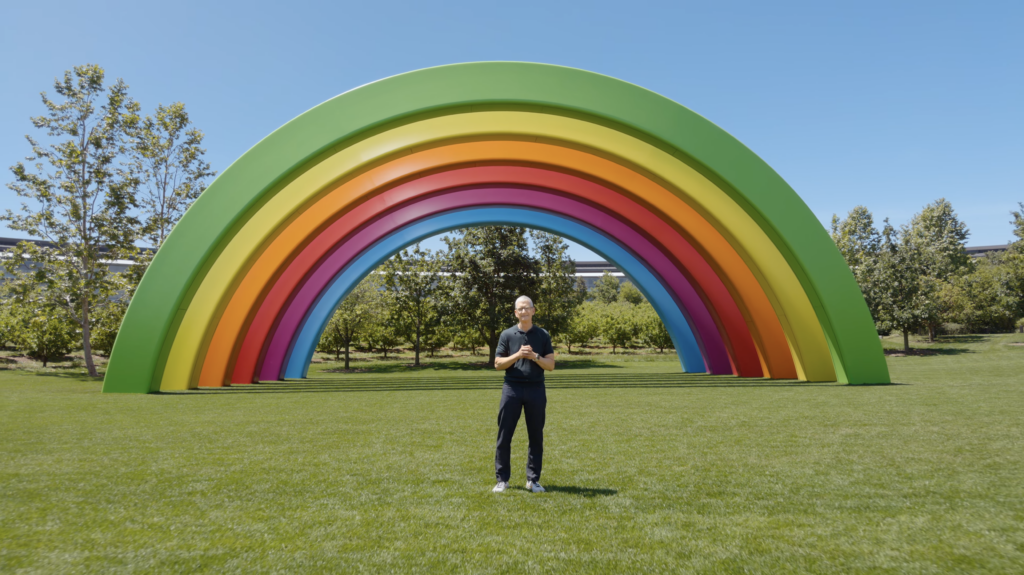
Last night, we watched the WWDC 2026 with great enthusiasm; it marked Tim Cook’s farewell and his imminent replacement by John Ternus (whom we didn’t see, as his role is still purely hardware-focused for the time being).
The content at a glance
A quick summary for those in a hurry
Whilst AI is playing an ever-greater role in our daily lives, with the boom in chatbots that are increasingly connected to our devices, one major player was conspicuously absent: Apple. What has become of the announcements made two years ago, when we were promised all manner of wonders? Users have been disappointed, and it showed. The new version of Siri, Siri AI (which won’t be available for several months), was highly praised during the presentation; we’ll come back to that later.
Other changes that were quickly overshadowed by these contrived announcements include a further improvement in security – a core value for Apple – and, above all, for children, who were the focus of the first part of the conference.
Since joining the company in 2011, he has expanded the Apple ecosystem from three devices (computer, smartphone, tablet) to eight, with the addition of the smartwatch, VR headset, AirPods, TV box and speaker — not to mention a whole ecosystem of services. Not bad for someone who took over from Steve Jobs.
And of course, to round off this summary, we have the new name for macOS: it’s macOS Golden Gate 🌉! We’re not leaving California, but we’re getting closer to Cupertino!
Changes for all users
Improved performance
As usual, the new operating systems promise better performance!
- Apps will open 30 per cent faster.
- Photos will be saved to the gallery 70 per cent faster.
- AirDrop will see a 60 per cent improvement in speed.
- Sending photos via iMessage no longer blocks other messages!
These improvements may seem minor at first glance, but they’re what will make you enjoy using your favourite devices even more!
New features!
As well as AI, which will be covered in a separate section a little later on, Apple has announced several new features that will delight some of us:
- the addition of an equaliser for AirPods (it remains to be seen whether it will be compatible with all headphones or exclusive to the AirPods themselves)
- Apple’s ecosystem is now compatible with Android and Windows: you can now create shared albums!
- iOS 27 is compatible with models up to the iPhone 11 — “the most compatible OS ever created”, according to Apple. It was about time! (But let’s not forget, whilst we’re at it, the watches that become obsolete for watchOS 27 after just four years)
- The comprehensive overhaul of Spotlight, which allows you to carry out in-depth searches across all documents, messages and more on your computer! (It reminds us very much of Foxtrot Search, which we’ve had the chance to test.)
Major change: the introduction of Siri AI
This is the headline announcement of this year’s WWDC: Apple has completely overhauled Siri to make it more useful and smarter…
A new architecture
The collaboration with OpenAI, which laid the initial foundations for Apple Intelligence, has now given way to Google Gemini. The system has now improved in terms of image recognition, visual generation and, above all, understanding of personal context: Siri knows what you’re doing, which app is open, and tailors its responses accordingly.
Siri as you’ve never seen her before
Siri AI is now a fully-fledged app with a conversation history. It can be activated from the Dynamic Island, understands what’s on the screen, can compare files on a Mac, correct your text and take dictation. You can even customise its voice (tone, speed and style)! It’s finally the real assistant that Apple has been promising us for years.
A real handy helper
Other notable new features include: a major improvement to image editing and cropping (finally making smart use of spatial images), integration with the Camera app to identify what you’re filming, a dedicated keyboard shortcut on Mac, integration with the Shortcuts app, and a new app grid on the Apple Watch.
As well as being able to read and understand the context on screen and take action (just as Claude Cowork already does on a computer), Apple’s AI is becoming even more useful and can change multiple passwords at once via the dedicated app.
The European downside
Siri AI will be available in the US in beta by the end of 2026. What about the European Union, which is always the one left out when it comes to new features? It won’t be available until at least 2027! Apple cited regulatory constraints in a press release. Yet another source of frustration for European users, who are already used to being the last to receive new features (fortunately, in Switzerland, we do still have access to them!).
Changes for families
Apple doesn’t just think of you, but also of everyone around you! Whether it’s through iMessage, FaceTime, shared albums or home automation… Apple makes it a priority to improve communication and organisation within your family. In fact, this is one of the key announcements from this year’s WWDC:
Managing children’s accounts
Although children’s accounts were introduced into the ecosystem several years ago, Apple has added new features relating to their security.
Parents can now better manage their children’s use of their devices. Screen time can now be set for several categories: Entertainment, Video Games and Social Media, and can be adjusted according to the day of the week.
Content security
In another update aimed at protecting children, Apple has introduced Start Focused, which allows parents to restrict access to content approved by an adult. It will then be possible to monitor app downloads, new contacts, web browsing and authorised apps…
In addition to this security feature, automatic blurring of any nudity in images is enabled, whether the image is displayed on screen, received via message or even shown during a FaceTime call.
Design changes
The mid-year WWDC is focused on software announcements, with the release of new operating systems. There are therefore no announcements of new products, but rather fundamental improvements and new features.
Liquid Glass
Following last year’s announcement of Liquid Glass, which received a mixed reception, Apple listened to the community and has included a slider to adjust the transparency of interface elements.
Whilst Liquid Glass is still struggling, a year on, to be integrated into non-native apps, the new settings demonstrate Apple’s desire to assert its unique artistic vision, whilst trying to accommodate as many users as possible. We hope that designers will gradually embrace it – and, above all, use it correctly.
See in Threads
In fact, this was one of the points we raised a year ago when Liquid Glass was announced: accessibility (which is, after all, a priority for Apple) suffered a setback, with users potentially encountering interface behaviour that was difficult to read.
Fundamental changes
Several other changes to the user interface and behaviour have been noted, though not all of them have necessarily been announced:
- adjusting the rounding of windows (a minor issue that has been widely highlighted on social media since last year)
- Launch Siri by swiping down from the Dynamic Island
- a redesign of the Dynamic Island featuring a gradient rather than a solid black block
- Redesign of the menu bar on Mac, with the removal of icons from context menus
- even more customisation options for wallpapers
- the ability to create personalised cards in the Wallet app
- Using touch controls to operate a Mac via screen sharing with Sidecar
- separate volume control for the alarms and the device
- adding a translucent effect to the menu bar in native apps (e.g. Notes)
- and many more to discover…
Changes for developers
Developers are once again at the heart of the conference (with over 100 sessions on offer, including the opening keynote!), even though they aren’t mentioned first – they’re only listed at the end of each topic.
Xcode is embracing AI (even more)
Apple has reached a significant milestone: Xcode 27 now natively integrates Gemini (Google), in addition to Claude Code (Anthropic) and Codex (OpenAI), which have been included since version 26. In short, you can use the AI assistant of your choice directly within your development environment, without having to switch between tools.
Agentic coding is also making its debut: Xcode can now connect to your AI agents, as well as to GitHub and Figma. The design-to-development cycle has never been shorter (and that’s going to come in handy here at O’Matic!).
Apple Intelligence opens up to developers
This is the most eagerly awaited feature: Apple is FINALLY making new APIs available to integrate Apple Intelligence directly into apps:
- Enhanced App Intents for better integration of apps with Siri AI.
- Image input in the Foundation Model: apps can now analyse and understand images using Apple’s model.
- Core AI is the brand-new framework that enables custom models to be run on the device.
- Resource Spotlight, Action Kit and Permission Kit enable more contextual and secure experiences.
A new testing environment integrated into Xcode: Device Hub
Source: Apple press release
This is THE new feature that delighted Thomas the most: a more powerful simulator built into Xcode 27, with the ability to generate multi-touch interactions, test app responsiveness and make adjustments to specific elements without having to emulate an entire device.
Child safety: new responsibilities
Apple has introduced a set of APIs dedicated to content safety for minors: Sensitive Content API, Permission Kit and Age Range, which developers can utilise to improve their apps. Apple is clearly encouraging developers to adopt them.
Final thoughts: fancy a bit of AI?
Has Apple caught up in the field of AI?
From our point of view, yes and no. AI plays a major role in our daily lives, and Apple had been lagging behind. Today, Apple has managed to catch up with the rest of the field, but the question is whether users will be convinced and will change their habits to start using Siri AI.
Market sentiment
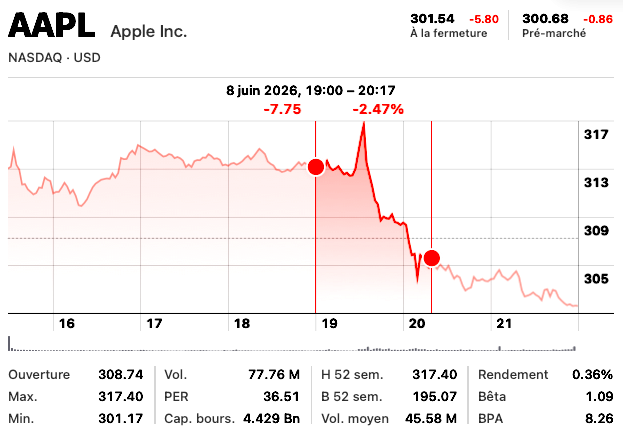
It’s quite interesting to look at how the share price has performed during WWDC. As you can see from the chart, there’s a spike that coincides exactly with the announcement of Siri AI. So, did all the investors sell to take profits, or are they unhappy? The trend seems to suggest that the share price isn’t heading for smooth sailing, even though it had been hitting record highs in recent weeks.

The design that’s been somewhat forgotten in a corner
As a designer, the new features have been rather modest… Just a few minor tweaks here and there; they’ve listened to the community but have ‘merely’ fixed the things that were a bit of an eyesore for designers. That said, with the introduction of Liquid Glass last year, it’s hard to get much more innovative than that!
What’s changing at O’Matic
This WWDC is important to both of us.
In terms of design and UX, this is an opportunity to rethink apps to place AI even more at the centre, without necessarily relying on external services. Utilising local processing power improves app speed, which is a real bonus in terms of performance!
On the development side, it will be even easier to integrate AI into apps thanks to the new APIs, and we’re looking forward to trying them out. This is what will transform our offerings the most; we hope to be able to integrate the same features into Android as well.
For a studio like O’Matic, access to AI APIs that understand the context and operate within the app presents a real opportunity to create even more useful and personalised experiences, such as with our in-house app, Transpo’matic, which we’re currently overhauling to create a more stable version for both platforms.
The September event
As usual, Apple will be holding its annual keynote in early September, where they’ll unveil their new devices and where we’ll meet John Ternus for the first time as CEO. It’ll be another chance to speculate about the launch of a foldable iPhone!
