News Published on by Thomas Borgognon
The history of AI: true intelligence?
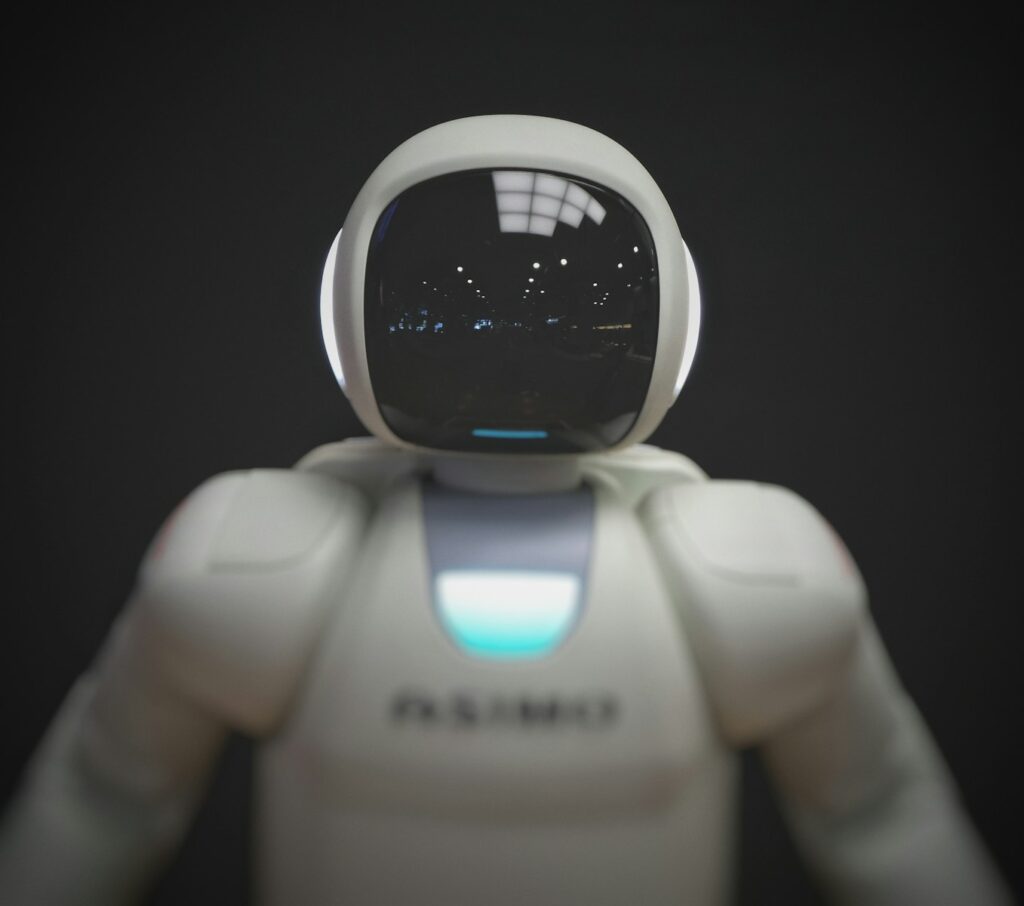
In recent years, we have seen AI popping up everywhere, in all areas, but what exactly is its history? How long have we been talking about artificial intelligence? Is it really intelligent?
At O’Matic, we often ask ourselves this question, as we see artificial intelligence everywhere, dozens of times a day. We went back to basics to discover its origins and understand its true nature: is it really intelligent, or is it just a very good algorithm?
What is AI?
When we talk about AI, we are referring to an algorithm designed to make decisions in a specific context. This is the simplest possible definition of artificial intelligence.
As a result, there are two types of algorithms:
- Rule-based: this is referred to as symbolic AI.
The AI simply follows the rules that have been provided to it beforehand: if given A, it returns B. - Learning-based: this is referred to as machine learning.
The machine determines a result based on its learning phase: if C is given as input, 90% of the statistics give the answer D. It all depends on the statistics and the mass of examples that have been analysed and the trend that has been drawn from them.
When did AI first appear?
AI as an algorithm dates back nearly 200 years!
The first computer programme appeared in 1843 thanks to Ada Lovelace, who created an algorithm for Charles Babbage’s analytical engine, which was never built.
In reality, algorithms, which form the basis of artificial intelligence, date back to ancient times, and some of them are still taught today (GCD, equation solving, etc.).
The idea of conversing with a non-human intelligence also dates back to ancient times. Are you familiar with the myth of Pygmalion, who fell in love with his creation, Galatea, who came to life thanks to the intervention of Aphrodite?
The idea of artificial intelligence is therefore not new and has always been a source of fascination. These examples are, of course, anecdotal, but they laid the foundations for the concept of artificial intelligence as we know it today: a ‘person’ who answers our questions.
When did digital AI start?
With the advent of the first computers, which were created in the 1940s with the ENIAC (a 170m² computer weighing 27 tonnes, capable of executing 90 computer programmes for solving numerical calculations), researchers realised that computers could achieve a high capacity for calculation and reasoning, faster than a human being.
In 1950, Alan Turing (also known for his contribution to the cryptanalysis of Enigma) conceptualised the Turing test, indicating a machine’s ability to converse like a human without another human being able to detect it.
This test was successfully completed in 2014 and led to the creation of the conversational AI models that we know and use today on an ongoing basis.
In 1950, the concept of artificial intelligence was already in people’s minds, but it was in 1956 that AI is considered to have been born with the Dartmouth conference, where several mathematical programmes were presented, notably to demonstrate theorems.
During this conference, two events will lead to the birth of artificial intelligence as we know it today:
- John McCarthy will present the alpha-beta pruning principle, which is an evaluation algorithm that will play a major role in the development of AI for chess programmes.
- McCarthy will convince the audience to use the term artificial intelligence for the field of computing in an official manner.
This summer of 2026 will mark 70 years since the birth of AI!
How has AI been used since then?
From his imagination, it can be found everywhere in the digital world:
- Between 1950 and 1960: the first digital chess games
- 1958: first neural network model
- 1959: first appearance of the term machine learning and its use in a draughts game
- 1966: first chatbot
- 1972: Release of Pong, where players compete against a machine.
- 2011: release of Siri, the first voice assistant
- 2016: DeepMind AI’s first victory in the game of Go (without handicap) against master Lee Sedol.
- 2017: Google releases language model databases
- 2022: emergence of the ChatGPT chatbot and the MidJourney and Dall-E image generation programmes
- 2025: release of the first browsers with integrated AI: Atlas (ChatGPT), Comet (Perplexity), Dia (The Browser Company)
We can also find AI as a conversational agent on websites to replace customer service or FAQs, as an information synthesiser (Google AI Overview), etc.
Why is AI experiencing such a boom today?
In reality, artificial intelligence is nothing new. What is new is the computing power offered by modern technologies over the last 15 years: the more powerful machines are, the easier and faster it is to create things.
Since the advent of Google and the web boom that we are still experiencing today (which preceded the AI boom), the web has accumulated a huge amount of data, known as Big Data. Thanks to Big Data, artificial intelligence has an infinite wealth of information and visuals at its disposal. And the more information and examples AI has, the more effective it becomes.
However, there are still some limitations: if the information and examples are incorrect, the AI will simply be wrong in its statements because its basis will be wrong.
It’s as if you had always been taught that 1 plus 1 equals 11, when we want you to give us the answer to 1 plus 1, which is 2. It’s all a question of vocabulary, learning, information, how you say things… otherwise AI will hallucinate.
Final remarks
If we just have to generate answers to questions, photos that all look alike, content based on the same examples, are we really dealing with a form of intelligence?
Artificial intelligence is an excellent synthesis algorithm, but for now, content generation remains fairly mundane.
At O’Matic, we are quite sceptical about the place AI occupies in the world. Although it is a useful tool that we use on a daily basis, we have decided to limit and moderate our use of it for moral, ethical and environmental reasons.
